Table of Contents
ToggleQuick Verdict
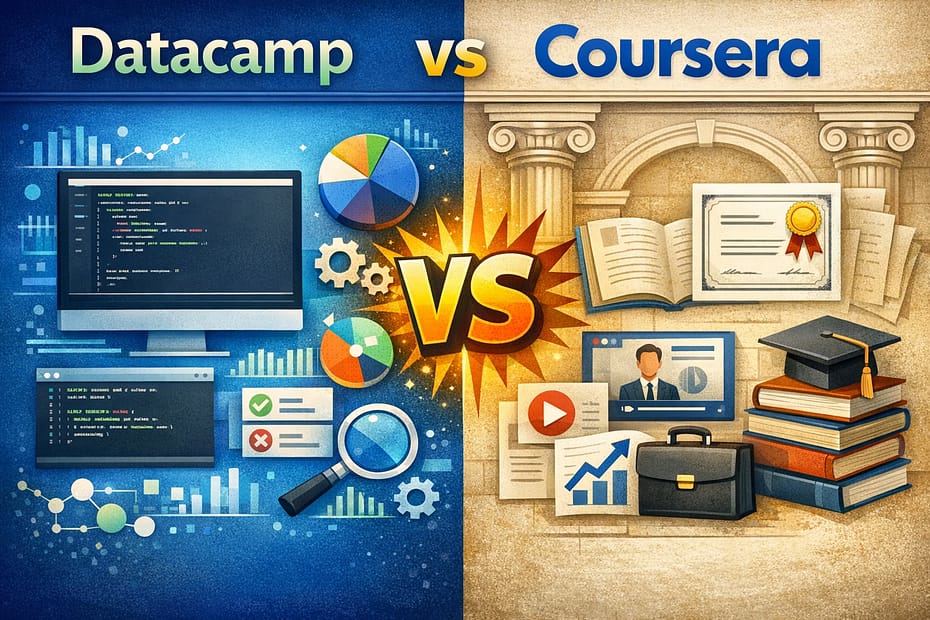
If your goal is practical data science skills fast, DataCamp is the cleaner, more efficient path. If you need recognised credentials, university-backed depth, or broader career flexibility, Coursera is the better bet.
| Coursera | DataCamp | |
|---|---|---|
| Best for | Degrees, professional certificates, academic depth, broad learning | Hands-on data science practice, coding fluency, skill-building routines |
| Price | Coursera Plus is $599/year | DataCamp Premium is $399/year |
| Our pick for data science | Strong, but depends on credential needs | Best overall for most data science learners |
After you decide, start here: Coursera or DataCamp.
What is Coursera?
Coursera is a large online learning platform founded in 2012 by Andrew Ng and Daphne Koller. It began with university partnerships to bring high-quality courses online and has since expanded into professional certificates, specialisations, and full degree programmes.
Today, Coursera serves 100M+ learners and partners with universities and industry leaders to deliver structured learning across topics, including data science, machine learning, analytics, and software engineering. For a deeper walkthrough, see this guide: The Ultimate Guide to Coursera.
What is DataCamp?
DataCamp is an online learning platform focused specifically on data science and analytics. Its course catalogue is built around skills employers actually hire for—Python, SQL, R, Power BI, Tableau, statistics, and machine learning fundamentals.
DataCamp's standout feature is its coding-first approach: most lessons use interactive, browser-based exercises where you write code immediately and get instant feedback. It's designed for momentum and consistency, especially if your main goal is to build real data science skills instead of collecting lecture hours. For the full breakdown, see: DataCamp Review.
Coursera vs DataCamp, Head to Head
Course Content & Depth
Coursera generally wins on formal depth and breadth. You'll find university-style data science courses, rigorous theory, and longer-form programmes with graded assignments, projects, and peer review. If you want a structured pathway like a professional certificate or even a degree, Coursera is built for that.
DataCamp is narrower (in a good way): it's highly concentrated on day-to-day data science skills—coding, querying, cleaning, visualisation, and practical machine learning basics. The depth is often "job-useful" rather than "academic." For most learners trying to become productive quickly, that's a feature, not a bug.
Edge: Coursera
Learning Style
This is where the Coursera vs DataCamp decision becomes obvious. Coursera leans heavily on video lectures, readings, quizzes, and projects. It can be excellent, but it's also easier to "watch" learning rather than do learning—especially if you don't actively code alongside the course.
DataCamp is built around repetition, practice, and immediate feedback. You're writing code early and often, which is exactly how data science skills stick. If you learn best by doing—and most people do—DataCamp has the advantage.
Edge: DataCamp
Pricing & Value
Coursera Plus is $599/year, and it can be great value if you'll take multiple long programmes, specialisations, or career certificates—especially if you'd otherwise pay per course. But you do need to actually use it to justify the cost.
DataCamp Premium is $399/year, and the value is straightforward if your goal is consistent, hands-on data science practice. It's cheaper, focused, and designed to keep you moving.
For most people comparing Coursera vs DataCamp for data science in 2026, DataCamp is the better value because it's more directly aligned to skill-building per hour spent.
Edge: DataCamp
Certificates & Career Value
Coursera tends to have stronger "credential optics." University-backed certificates and well-known professional certificates can look more credible on a CV, especially if you're pivoting careers and need recognisable signals. Hiring managers won't treat every certificate equally, but Coursera's top programmes can carry weight.
DataCamp certificates show commitment and skills practice, but they're usually less recognised than Coursera's bigger brand credentials. DataCamp shines more as a skills platform than a credential platform.
Edge: Coursera
Best For Beginners vs Advanced Learners
Beginners usually need two things in data science: (1) clarity on what to learn next, and (2) lots of practice. DataCamp handles both well, especially for Python, SQL, and foundational analytics workflows.
Advanced learners often need deeper specialisation, stronger projects, and sometimes academic-level rigour. Coursera's ecosystem makes it easier to go deeper into machine learning, statistics, and structured pathways—especially when you choose well-rated programmes and commit to the assignments.
Edge: DataCamp (beginners), Coursera (advanced)
Job Outcomes
Neither platform guarantees a job. What matters is whether you can produce evidence: projects, a portfolio, and interview-ready skills. DataCamp is excellent for building day-to-day coding fluency in data science, which helps performance in practical interviews and on the job.
Coursera can be stronger when your target role values structured credentials or you need a more formal learning arc. If you're considering alternatives that lean even harder into job-ready nanodegrees, compare with: The Ultimate Guide to Udacity.
If we're being direct: most people stuck in "learning mode" don't need more lectures—they need more practice. That's why DataCamp often leads to faster practical readiness in data science.
Edge: DataCamp
Who Should Choose Coursera?
- You want recognised certificates (or even a degree pathway) that signal structured learning to employers in data science and beyond
- You learn best with long-form instruction, assignments, and academic depth—and you'll actually complete them
- You want flexibility beyond data science (business, computer science, project management, etc.) all in one platform
Try Coursera → Get started with Coursera
Who Should Choose DataCamp?
- You want to build data science skills by coding, not by watching—Python and SQL practice is the priority
- You're a beginner who needs a clear, practice-heavy path to become productive in data science quickly
- You want the best value for consistent skill-building with a data science-first platform
Try DataCamp → Get started with DataCamp
Our Final Verdict
DataCamp wins for the typical data science learner who wants job-relevant skills fast and learns best by doing. Start here: DataCamp.
Coursera wins for learners who need recognised credentials, academic depth, or broader career pathways alongside data science. Start here: Coursera.



No related posts.